Burnout: Name it to tame it
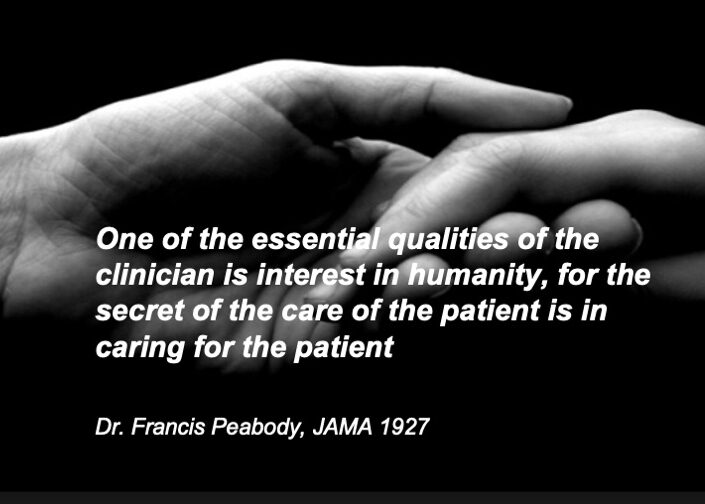
A patient centered care model should not denigrate how we take care of ourselves; nor sacrifice ourselves to take care of the patients.
Person-centered care looks at how we take care of ourselves and each other.
How are we doing? What the data says:
58-64% of nurses, GPs, specialist physicians describe their worklife as highly stressful (so stressed that they do not have time to stop and ask if this is what they really want in life.)
- 42% of Canadian physicians screen positive for depression.
- 21% experience high anxiety
- Suicide in male physicians is twice the national average and 3 times the national average in female physicians
- 46% of physicians meet the criteria for burnout
Burnout: a syndrome of emotional exhaustion involving the development of negative self concepts, negative job attitudes, and a loss of concern and feeling for patients.
Drivers of burnout: work overload, chaotic environment, time pressures, information overload, loss of control, insufficient reward (not just financially: purpose, meaning, feeling seen), breakdown of community, absence of fairness, conflicting values, loss of meaning: why you specifically started medicine.
The neurobiology of burnout:
- Enlarged amygdala
- Reduced levels of neurotransmitters
- Thinning of the prefrontal cortex
- Impaired memory and attention
- It is a form of Trauma
Effects of burnout personally:
- increased risk of broken relationships
- Increased risk of alcohol and substance use.
- Increased risk of depression and suicide
Effects of burnout professionally:
- decreased quality of care and increased medical errors
- decreased patient satisfaction
- decreased productivity and professional effort
- physician and other healthcare provider turnover
Stress reaction vs. stress response:
It is not always about the stress itself, but sometimes the stories we tell ourselves about the stress.
- Autopilot sympathetic reaction – fight, flight or freeze. Blood pressure increases, more oxygen. Immune system downregulated, digestion downregulated, blood leaves prefrontal cortex, hindbrain lights up.
- It is not just a real threat that provokes these reactions, but a perceived threat can also do so. Examples: overwork, difficult relationships at work, finances, uncertainty.
There is a way to bypass this automatic response!
Practicing Mindfulness
Mindfulness is…
- Paying attention on purpose in a particular way without judgement.
- Attention is the most basic foundation of love, and self love. Mindfulness is an act of love and self-compassion.
A common default mode network…
- Ruminating, remembering, emotions, thinking of the future
Think about it…
- What is here now? You are here now. But we aren’t always connected to ourselves being there.
Mindfulness is interfering less and less with what is actually here.
- Mindfulness is a set of skills that we can practice to be more awake and less caught up in the future and in the past.
- Are we mind full or mindful?
Mindfulness…
- Increases athletic performance
- Increases math scores and decreases bullying in school
- Neuroplasticity
Meditation - What it is, why it matters
What is meditation?
- Practice of concentrated focus upon a sound, object, visualization, the breath, movement or attention itself, in order to increase awareness of the present moment, reduce stress, promote relaxation, and enhance personal and spiritual growth.
- But all this can be shortened to – exercise for your brain. Meditation is just exercise for your brain.
- The area of the brain that controls fine motor movement of the thumbs, is 30% larger in a functional mri of the average person than it was about 40 years ago.
- We grow neurosynaptic connections and grow the grey matter in our brain with repeated actions.
- When you practice attention, compassion, concentration, nonjudgement, you develop these connections and capacities and further cultivate them and grow the areas in your brain responsible for these. Medication also decreases atrophy of frontal and prefrontal cortex.
Meditation 5,4,3,2,1
Exercise: Practice meditation: 5, 4, 3, 2, 1
- Name 5 things that you can see. Pause with each other and noticing with a sense of curiosity and wonder the texture, shape, form and colour of the things you see.
Close your eyes now.
- Name 4 things you can hear. Pause with each one.
- Name 3 things you can feel (sensations).
- Name 2 things you can smell
- Name 1 thing you can taste.
Now turn your gaze inward to notice the inner landscape. Notice the body as it is right now. Notice if it feels tired, particular sensations, agitation, and just allow whatever is here to be as it is without judgement or trying to change it.
Observe the mind now. Watch the flow of thoughts as they pass, if the mind is busy or quiet, if there is a sticky or persistent thought.
Notice your feeling state. Notice your heart right now. Is there joy, anger, frustration? Experience it without judgement
You can slowly open your eyes.
How to cultivate meaning in medicine
Explore what is the most important thing for yourself, and remember it.
A study on palliative care in the New England Journal of Medicine showed that offering palliative care at diagnosis instead of waiting until the later end of someones life, and talking about what is important to them, what a good day looks like, comfort care, what is valuable led to patients living longer, with less aggressive treatment, better management of depression and anxiety, less exhausted, and more connected.
- Why do we wait until the end of a life to talk about what is meaningful what is important and what is a good day, when we can do this everyday and help us remember the most important thing?
We have 3 places where we find purpose in life:
- Purposeful work or creativity
- Love, love relationships, beauty, nature, people
- Courage in the face of suffering, meaning in the face of suffering
We don’t see things as they are, we see things as we are.
- Sometimes we may not see medicine as it is. It is a privilege to serve, help, transform lives, touch people’s lives, very few professions have this ability.
Compassion vs. empathy:
- Empathy: our ability to take the perspective of and feel the emotions of another person.
- Compassion: the concern to enhance the welfare of another who suffers or is in need.
No Mud, No Lotus
“Do not try to save the whole world, or do anything grandeous, instead create a clearing in the dense forest of your life and wait there patiently until the song that is your life falls into your own cupped hands, and you recognize and greet it. Only then will you know how to give yourself to this world so worthy of rescue.”
Gratitude Exercise
Write or type for 1 minute everything you are grateful for without thinking too much about it. Notice the expression on your face after this exercise, and how you feel in your body now.
- Sometimes we forget how blessed we are in our lives, but we can remember the small things we are grateful for. Foods, children, family, home – keeps us connected.
- If we have a splinter, while trying to remove the splinter, remember we have an entire body that is not splinter, a spirit that’s not splint, a life that’s not splinter and a world that’s not splinter.
It doesn’t deny the hardship, it just holds it in a bigger container.
Audience Q&A
Question: How do I make patients feel loved and cared for with our limited time together while respecting my own time and boundaries?
Answer: It is very much a balancing act. We can focus on the quality of the time together with the patients instead of the quantity. We can show concern for the patient and ask them to come back and address the issue next time. Show an inner posture of kindness, compassion and generosity. That intention will come through to your patients.
Q: How do we start, as individuals? As an institution?
Answer: Start where you are. How do you treat yourself? How do you take care of yourself in the busyness of the work that you do? Notice your habits, see what you are doing, so you are aware and see what you may need to change. Smaller mindfulness groups offered to really go into the how, but asking the question how, and attending these workshops are a great way to start. Bring humanity back into the fold of what we do. It can so easily be lost because we are so busy.
Q: Interested in any group sessions or courses?
Answer: bcalm.ca has the resources for patients, and physicians an 8 week course. Twice a year Mark has a workshop in the spring and in the fall, small groups, half day. Three times a year Mark offers a meditation retreat for healthcare professionals, which are often 5 days in various cities on Vancouver Island.
Q: Any tips on staying present despite our minds regularly oscillating between thoughts?
Answer: Remember that the default network will take us there, so it is normal. But if you have an anchor, which can be our breath, mantra, body sensation, sound, the moment we notice that we are thinking, planning or not present, it is a moment of practice. It loosens our attachment to thinking and planning, because we realize it is not us, but something we are observing.
Q: Do you find the dichotomy of meditation practice versus real world implementation exists for you? If so, have you noticed a change over time?
Answer: The spiritual journey is one of remembering and forgetting. Sometimes we forget the most important thing. It is normal to forget some of these teachings. The practice lets us have a loving and compassionate relationship with ourselves, as perfectly imperfect as it may be, that we forget that the return to remembering what’s most important in life, in work, with family. The remembering is beautiful. Remembering and forgetting is part of the process.
Dr. Lawrence Cheng addition on this topic: We can look at how we create those venues for remembering and reminding each other as a community and build that into the community of what we do every day.
Q: How did you integrate these learnings into your work, meetings, leadership opportunities?
Answer: We try to meet people where they are not where we think they should be. Having the courage to be vulnerable and have brave conversations but not inviting people where they aren’t comfortable going.
Example: Mark practices a 2-minute grounding before a big board meeting at his division. Or using a mindful communication strategy where they begin with gratitude. Focusing on inner posture of compassion, presence.
Comment from Ana-luiza: We can focus more on the gratitude and the positives of our work. Maybe have a few minutes to talk about wins before every meeting or a gratitude reflection before our meetings.
Cultivating meaning in medicine
1. Remember the most important thing
2. No Mud, No Lotus. Just because there is challenge doesn’t mean there isn’t beauty
3. Have an attitude of gratitude
4. Disconnect to reconnect: Put down your phones, computers, and have real conversations with real people, go for a walk, be in nature.
5. Practice medicine as an act of love. |
It’s not just the amount of stress, it’s the stories we tell about it. It’s the relationship we have with stress that affects if we suffer or thrive.Attention is the most basic foundation of love, and self love. Mindfulness is an act of love and self-compassion.Don’t turn away, keep your gaze on the bandaged place, that’s where the light enters you. – Rumi

|